.svg "Complex Care Management Logo (2)")
Recommendations for improvements to community mental health services
Community mental health providers have welcomed the findings of a cross-party inquiry which calls for greater recognition of psychiatric conditions and improved funding for out-of-hospital services.
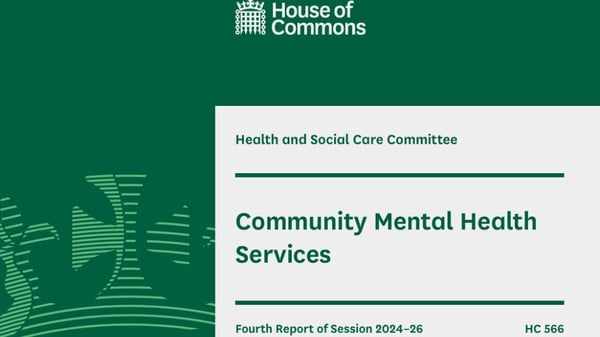
The Health and Social Care Committee’s latest report from its Community Mental Health Services inquiry, published on 2 December, made a series of recommendations for improvements to community services and criticised the current short-term funding approach.
“Mental health services are failing too many people,” the report states.
“As a cross-party group of MPs we hear heartbreaking stories from our constituents, whether it be individuals who struggle to navigate a complex, poorly-resourced system; clinicians frustrated that they can’t provide the level of care they would like to; or, worst of all, families who have tragically lost loved ones knowing they could have been saved if care had been more responsive.
Our recommendations nudge, urge, and compel this, and all future, governments, and the NHS itself, to recognise the continued disparity of esteem between mental and physical health and to continue to battle against it
“At a time when the NHS is under enormous strain, we understand competing pressures, but we must actively resist letting mental health drop down that priority list.
“Our recommendations nudge, urge, and compel this, and all future, governments, and the NHS itself, to recognise the continued disparity of esteem between mental and physical health and to continue to battle against it.
“Too many people with severe and enduring mental illness are continuing to fall through the gaps of our community mental health services.
“Many experience unacceptably-long waits to access care, are discharged without ongoing support while they are still in recovery, and are denied care because they do not meet arbitrary thresholds.
“Too often, support is only available when people reach crisis point.”
Perfect timing
The timing of the inquiry, which heard from people who have experienced the system, was significant; running in parallel with the progression of the Mental Health Bill’s passage through Parliament.
The inquiry team said the Bill’s reforms depend on the availability of ‘robust community services’, underscoring their critical role in delivering safe, effective alternatives to inpatient care.
But they said ‘previous efforts to transform services have not translated into system-wide improvements in access, outcomes, and experience for service users’.
The loss of ringfenced Service Development Funding and uncertainty around the Mental Health Investment Standard (MHIS) threaten to undermine the transformation of services
To deliver ‘meaningful’ transformation, the report calls for ‘a fundamental reimagining of mental health care as trauma-informed, person-centred, and rooted in a social model’.
It adds: “This will take bravery, leadership, and unwavering political will.
“Failure to act risks worsening outcomes, deepening inequalities, and will lead to further preventable harm and tragic loss of life.”
Neighbourhood centres
The report calls for a 24/7 Neighbourhood Mental Health Centre to be available in every community.
It states: “The pilot of six centres across England offer hope towards a system of open-access, holistic support rooted in local communities, and early evidence suggests reduced inpatient admissions and improved continuity of care.
“However, short-term funding cycles, lack of digital interoperability, workforce shortages, and unclear plans for national scale- up all threaten the pilots’ chances of success.
“Without sustained investment and a clear strategy for expansion, we are concerned the impact will be limited.
“We recommend that the pilot programme be extended by at least 12 months beyond April 2026 and we expect the Government to develop and publish a clear roadmap for national scale-up of the pilot programme.”
Funding
Funding for community mental health services was a key element of the report’s recommendations.
It states: “Funding remains a critical barrier to progress.
“Mental health accounts for over 20% of the disease burden, but receives less than 10% of NHS expenditure.
“The loss of ringfenced Service Development Funding and uncertainty around the Mental Health Investment Standard (MHIS) threaten to undermine the transformation of services.
“We recommend that the MHIS be retained beyond 2025/26 and that Integrated Care Boards move away from short-term commissioning cycles.”
This important report rightly acknowledges the significant progress made in the sector towards the kinds of community health services that people with severe mental health services need. It’s also honest about how much further there is to go
And it calls for digitisation of services, stating: “Digital integration has been a persistent challenge.
“The lack of shared care records and data-sharing agreements, particularly with voluntary organisations, hinders collaboration and evaluation.
“We urge NHS England to address digital interoperability by collating and sharing learning and best practice, to ensure future systems can implement the pilot model effectively.”
Other recommendations include:
- New national mental health access and waiting time standards for community mental health services
- A renewed commitment by the Government to realise the Community Mental Health Framework ambitions and an independent and comprehensive evaluation of its implementation to date
- Holistic support to help people with mental health problems get back into work and community life
- Every person with a severe mental illness to have access to a named mental health social worker
- Reinstatement of the annual physical health check target for people with severe mental illness
- ICBs to move away from short-term commissioning cycles to multi-year contracts for voluntary, community, and social enterprise (VCSE) organisations supporting the delivery of community mental health services
- Creation of an actionable plan for transition from Children and Young People’s Mental Health Services to Adult Mental Health Services
- The Government to expand the use of Section 75 of the NHS Act 2006 by enabling and encouraging more-widespread pooling of budgets between NHS bodies and local authorities
- A clear commitment from government towards parity of esteem between mental and physical health
- Specific measures to reduce staff burnout, including action on caseload management and access to supervision; improvements to pay and progression opportunities; and comprehensive training and continued professional development
- Recognise the important role of mental health social workers by including them in the upcoming 10-Year Workforce Plan
NHS England data shows that 608,896 people were diagnosed with severe mental illness in 2023-24.
This is down from 621,896 in 2022-23 – the highest on record – but a significant increase in the last 10 years.
Welcoming the report, Rebecca Gray, mental health director at the NHS Confederation, said: “This important report rightly acknowledges the significant progress made in the sector towards the kinds of community health services that people with severe mental health services need.
“It’s also honest about how much further there is to go, and its recommendations – which will align well with what most of our Mental Health Network members say – speak to what would support that change.
“Support for open access models like the new 24/7 pilots, and the need to ensure we have adequate evidence around their impact is welcome.
“Welcome, too, is the call for greater transparency on and commitment to responding to long waits in community mental health services.
“We also welcome the focus on how to increase the ability of NHS and voluntary, community, and social enterprise (VCSE) organisations to work effectively in partnership.
“Our members know that, with appropriate funding, these partnerships are key to delivering wraparound care in ways that work best for patients.”